Friday 10 Feb 2023
Balfour Beatty (LSE: BBY) has been a zero growth infrastructure builder, financier and maintainer for a decade; with sales more or less flat at £7bn over the period.
What’s more, the business is barely profitable. Operating margins hit a high of 1.5% in FY ’19, albeit up steadily from a low of -5% in FY ’14 (Exhibit 1).
Exhibit 1: BBY has been a low growth, low margin business historically

Source: Company filings
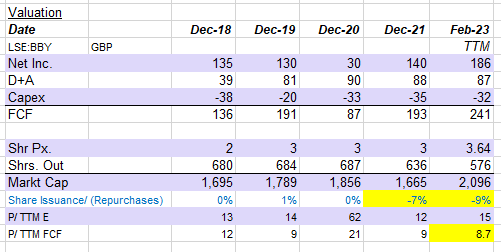
However, with depreciation and amortisation charges exceeding capex, and high single-digit percentage share buy-backs in recent years, the firm has seen FCF per share grow from £0.28 in FY ’19, to £0.42 in the TTM to Jul-22. With shares at £3.64 currently, it trades at an undemanding 8.7x FCF multiple (£3.60/£0.42). (Exhibit 2)
Exhibit 2: Share repurchases and FCF growth have made BBY trade at a cheap multiple
Source: Company filings
Rather than running down cash reserves or employing debt, BBY uses cash from operations to finance the share repurchases. The company operates with £361m in net cash on its balance sheet.
The company is set to buy back up to a further £40m in stock (2% of market cap) by May 2023, and expected to announce further buybacks at its full year results in March, which will further increase FCF per share.
Buybacks of the scale seen in 2022 would drop the firm’s price to FCF per share multiple to 7.8x, well below the medium term average of 12x. A re-rating to past levels would present 50% upside.
The business
Founded in 1909, today’s BBY generates over 80% of its sales from its “Construction Services” segment. In this unit BBY engages in multi-million pound, large scale and complex infrastructure construction mainly in the UK and US. Some examples include:
- The £416m project to build seven kilometres of sewage tunnels (Thames Tideway Tunnel “West” section). A key challenge here was removing 800,000 tonnes of clay from a site in central London while minimising the pollution from transportation. They removed the spoil via barges, reducing the lorry-load on London’s roads by 25,000.
- The £592m project to build new departure lounges at Heathrow, one of the largest airside projects in Heathrow’s history. The project was completed 5 weeks ahead of schedule and £10m under budget, with the new building 40% more carbon efficient.
In 90% of these projects the customer is a local or national government entity. BBY bids for construction projects and then is responsible for delivering the bridge or tunnel, etc. But this doesn’t leave BBY totally exposed to inflationary pressures. Customers assume liability for the sourcing and supply of building materials, hence bear the cost of price rises on that front.
In addition, to further insulate itself from inflationary pressures, the company uses “buy outs” to pass the cost liability down its supply chain. As of March 2022, 85% of US contacts (50% of group sales) are “bought out” – liability passed to suppliers – within 30 days of getting awarded a contract. But if a subcontractor goes bankrupt, its BBY’s liability to the customer, emphasising the importance of BBY’s knowledge of its suppliers.
The depth and breadth of BBY’s supply chain gives it an advantage in bidding for contracts
Core to BBY’s success is it’s supply chain. The scale of, and expertise within, BBY’s supply chain affects the price they bid for projects and its ability to successfully deliver on time and on budget. In turn, BBY’s ability to win contracts and deliver nourishes its relationships with customers (mostly local and national governments), supporting further wins.
Its supply chain consists of over 10,000 partners, many of which BBY has worked with for over a decade, some of which for over thirty years. Over two-thirds of BBY’s revenue is spent on procuring goods and services from its suppliers.
Some history
In mid-2014, BBY was Britain’s largest construction firm, but was fighting off a takeover bid by rival Carillion.
The firm was bogged down by a large stockpile of low-margin contracts it had accepted following the global financial crisis, and had issued eight profit warnings over the past two years.
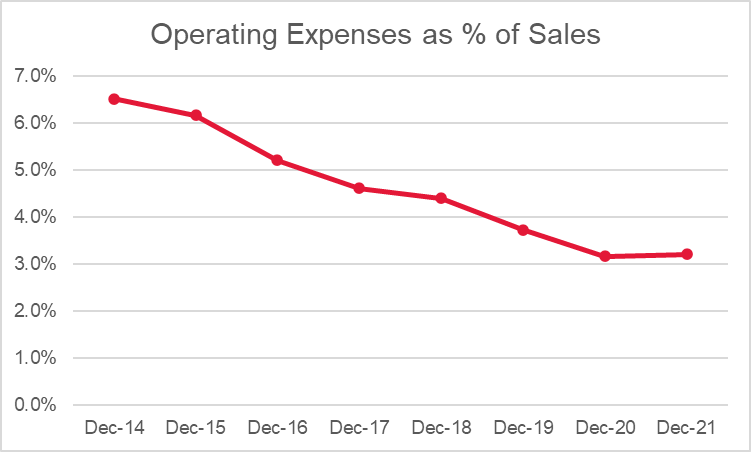
In January 2015, CEO Leo Quinn was appointed who initiated his “Built to Last” programme, one month into his role. Key to this initiative has been streamlining operations, for example selling off assets in the Middle East and stakes in the M25 Connect Plus consortium, re-organising some areas of leadership and greater diligence when acquiring new contracts. This has led to a steady decline in operating expenses over Quinn’s tenure (Exhibit 3)
Exhibit 3: Leo Quinn’s “Built to Last” initiative has halved operating expenses over 7 years
Source: Company filings
 The Equity Analyst