SELL CARVANA (NYSE:CVNA)

Inflated related-party loan sales risk SEC probes and significant falls in EBITDA ahead

Our investment in Carvana has been a great one, but now it is time to sell out.

From our first purchase of shares in May 2022 at ~$40 per share, we took profits on 75% of our position in Oct 24 and Nov 24 at ~$170 and ~$230 per share — about 400% and 600% returns, respectively.   The remaining 25% has an unrealised gain of 1,000%.  (Makes me think we should have kept holding onto the whole lot!)

The reason why we held Carvana through this period was the impressive operational advantages it appeared to be gaining over its peers through its vertically integrated model, with a long runway of growth potential through market share capture.

However, valuations do matter when thinking about returns.  Shares currently trade at 91 times trailing twelve month earnings and 72 times TTM free cash flow, suggesting high growth expectations.  They were trading at over 100-times these multiples on our initial sales.   

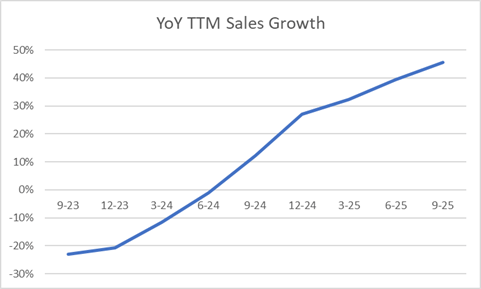
Bulls, however, would rightly point out that our previous sales proved premature and sales growth has been accelerating, justifying the high multiples (Exhibit 1)

Exhibit 1: Carvana sales growth has been accelerating, on rolling TTM basis
Thus, in and of itself, the valuation argument is a weak one. 

Key concerns of aggressive earnings management, however, have been raised in a recent “short seller” report by Gotham City Research on the 28th January 2026.  Gotham has claimed that Carvana’s reported profits have been materially driven by related-party transactions that shift economic losses away from its public books and onto an affiliate.  According to Gotham City Research’s report, a large portion of Carvana’s reported gains on finance receivable sales appears to come from selling loans at inflated values to a related entity (DriveTime, a company controlled by the father of Carvana’s CEO). This effectively shifts economic losses onto that affiliate while boosting Carvana’s public-facing earnings. 

These Gain on Sale profits accounted for 55% of Carvana’s 2024 EBITDA ($755m vs. $1,378m total). 
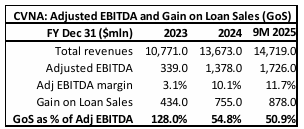
Source: Gotham City Research Carvana Full Report

These sales at an inflated price, helped Carvana go from having negative Cash Flow from Operations in all years prior to 2022, to positive in 2023 and 2024.  Shockingly, DriveTime posted operating losses at just the time Carvana posted their gains, supporting Gotham’s claim that the private company DriveTime is taking on losses enabling the publicly traded Carvana to post profits.

To fund these losses – and the purchases of the loans from Carvana – DriveTime has taken on a tonne of debt.  Gotham’s report claims DriveTime’s net debt is “20-40x 2023 and 2024 Adjusted EBITDA, well above the historic level of 5-10x”. 

Source: Gotham City Research Carvana Full Report

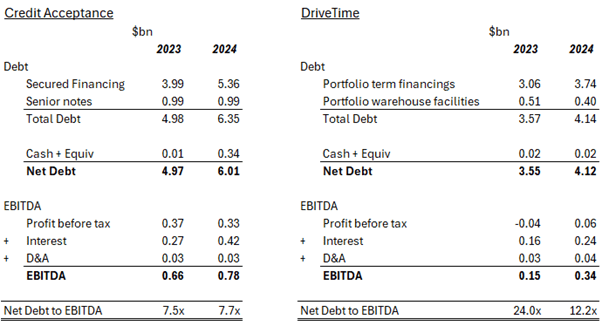
Gotham’s report also states this level of leverage is way above another U.S. Subprime Auto Lender, Credit Acceptance, who’s Net Debt to EBITDA was closer to 8x in 2023 and 2024:

Source: Gotham City Research Carvana Full Report

By going through the annual reports for both DriveTime and Credit Acceptance I was able to verify Gotham’s figures.  While my calculations for DriveTime’s leverage at 10-25x, was lower than their calculation, it’s still an incredibly high level of leverage, and around double that of Credit Acceptance:
The key concern now is, once the lenders read this report, DriveTime will struggle to borrow more, and hence will no longer be able to buy Carvana’s loans at a premium.

We’ll find out for sure if this is true in the next few quarters.  If DriveTime stops buying at a premium, Carvana’s source of half its EBITDA will disappear.

In ending, it’s worth mentioning that in October 1990, Ernest Garcia II (owner of DriveTime) pled guilty to a federal bank fraud charge related to his role in the collapse of the Lincoln Savings & Loan Association — a major savings-and-loan institution at the centre of a high-profile financial scandal in the late 1980s and early 1990s.  Prosecutors said Garcia acted as a “straw borrower” – he was a real estate developer who took out loans in his own name to conceal Lincoln’s true exposure to certain real-estate assets from regulators.

The wrongdoing was about misrepresentation in lending and disclosure – which looks to be the same thing happening here.
The Indian billionaire that founded India’s third-largest lender

Monday 13 November 2023

Source: FT, “Its better to be stupid now than sorry later”

Here are the main points:

1. Uday Kotak started the business offering bill discounting, its now India’s 3rd largest private lender.

2. His 26% stake of Kotak Mahindra is worth more than $13bn

3. Share price has underperformed after he quit in Sept, with concerns on firm’s dependence on him.

4. 2014 merger with ING Vysya Bank gave them scale.  

5. After 2016 government initiative to withdraw currency, Kotak launched “811” the digital banking service.

Head of Japanese exchange is trying to raise P/B ratios of TSE stocks

Monday 6th November 2023

Source: FT, “Hiromi Yamaji: The banker turned stock exchange boss rattling Japan’s listed companies

Main takeaways:

1. JPX boss plans to create a published list of companies that have stated they will make improvements, on 15th Jan 2023.

2. 50% of stocks on the Japanese exchange (TSE) have a price to book ratio less than 1.0. This compares to 5% in S&P 500 and 19% in Stoxx 600.

3. To raise PBRs Japanese companies have been launching share buybacks, selling non-core assets and appointing independent directors.

4. Buybacks and dividends in Japan hit an all time high of 25 tn Yen

5. Japanese Topix is up 20% this year, vs. SPX +14% and STOXX 600 +3.5%

Originals: How Non-Conformists Move the World, by Adam Grant

Tuesday 6th June 2023

Buy Originals from Amazon

  1. Key insights
    1. Original thinkers produce more ideas than non-originals
    2. Industry peers are the best people to judge the quality of your ideas
    3. Success is based on the execution of the idea, not the quality of the idea
    4. Don’t make suggestions unless you have status
    5. Be the one that points out all the weaknesses of your own ideas
    6. Make your ideas seem less radical and present analogues to what the audience already knows
    7. Create a sense of urgency to gain adoption of your ideas
    8. If your idea is about gains, your audience will choose the smaller more certain option

Key insights

Original thinkers produce more ideas than non-originals

Produce three-times more ideas than you would normally. Originals aren’t better at judging the quality of their ideas – they just produce more ideas. This gives them more variation and therefore more chance of originality. Thomas Edison, famous for creating the lightbulb, had 1,093 patents. When it comes to idea generation, quantity is the most predictable path to quality.

Industry peers are the best people to judge the quality of your ideas

Fellow creators (in the same field) are the best judges of the quality of new ideas. The creators themselves are too optimistic. On the flip side, managers, audiences and customers also fail to correctly predict the success of novel ideas because they compare them to what they have seen succeed in the past.

When evaluating ideas managers and experts typically look to historical precedent to make judgements on quality – because those prototypes have lead to their previous successful decisions in the past. They also tend to be more focussed on what could go wrong so tend to miss out on the most original ideas. This caused studio executives passed on hits like Star Wars, E.T., Seinfeld and Pulp Fiction. The same is true in corporations: the laser printer was nearly cancelled at Xerox for being expensive and impractical; the X-Box was nearly abandoned by Microsoft.

Success is based on the execution of the idea, not the quality of the idea

When evaluating whether an idea is likely to succeed, we have to look to the likelihood of that idea being successfully delivered.

If we want to forecast whether the originators of a novel idea will make it successful, we need to look beyond the enthusiasm they express about their ideas, and focus on the enthusiasm they have for execution that they reveal through their actions

Are they rehearsing and re-evaluating their concepts to make sure they get the execution right? Are they the guys still working at midnight just to make sure the smallest detail is done right?

Don’t make suggestions unless you have status

Power involves exercising authority or control over others, status is being respected and admired. If you try to exercise power without status, you will be punished by the people you are trying to exercise power over.

When you are presenting new ideas, you are in effect telling people what they should be doing. When these are people that have the power to make the decision, you have to make sure they don’t feel undermined in your approach.

To do this, use phrases like, “maybe I’m wrong, but..”. Also, make sure to present all the weaknesses in your ideas upfront.

Be the one that points out all the weaknesses of your own ideas

By presenting all the weaknesses and problems upfront – the reasons why they shouldn’t invest – it brings the audience at ease that you are not trying to hide something from them. It makes them your ally – can they help you solve that problem?

Not only does it convey that you are trustworthy and modest, but also that you are knowledgeable and that you have thought things through.

Newton’s third law can also apply in human interactions: every action has an equal and opposite reaction.

Make your ideas seem less radical and present analogues to what the audience already knows

To get an audience to buy into a novel idea, you need to help them to see why it is similar to something they already know. When Disney was looking to produce their first ever original story film, The Lion King, the board were reluctant to sign-off on the idea until it was presented as being “Hamlet with Lions”.

Create a sense of urgency to gain adoption of your ideas

The key difference between programmes that got wide-scale adoption vs. others was that the successful ones created a sense of urgency. It was not about creating an emotion or the clarity of the message.

If your idea is about gains, your audience will choose the smaller more certain option

Your idea might be about some benefit or avoiding some loss. But depending on what you are presenting, it will affect how open your audience is to taking a chance. For example, when faced with a small guaranteed loss, an audience might be more willing to flip a coin to avoid this loss even with the potential for greater loss. By contrast, when a small gain is almost certain (a business continue operating as usual) they are less willing to try something new with higher potential gains.

This is why when you are presenting an idea that requires your audience to shift from their current solution (i.e. take a risk) you must show first why they are facing a “guaranteed loss” and thus make them more likely to try something new.

BUY Nolato – the glo concerns are wrong

April 2019

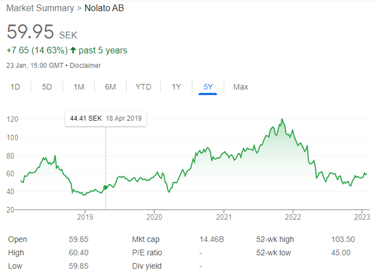
In April 2019, while working for StockViews, I wrote up a BUY note on Nolato, the Swedish specialist plastics manufacturer.

The stock had fallen 50% in 9 months on the back of concerns the key revenue driver was faltering; the manufacture and sale of Vaporiser Heating Product (VHP) smoking devices to BAT. 

In July 2018, the Wall Street Journal had reported on the Philip Morris injunction on the sale of BAT’s “glo” VHP devices in Japan (its largest market) on patent infringement grounds.  If BAT could not sell in Japan, it wouldn’t need Nolato to make anywhere near the same number of devices for it.

Through my primary research, I found the market had overlooked a key detail in the patent infringement filing.  Namely that the ban was only applicable to the current VHP model, and Nolato was set to release the new model for BAT within months.

By emailing and getting response from BAT’s general council I was able to verify this fact.

Furthermore, BAT’s reliance on the Japanese market was likely to diminish over time as the company rolled out its product into new markets.  BAT had 2m customers across 15 markets, while PMI – the market leader- was already in 45 and had 10m+ customers of their IQOS product, including the US.  BAT had filed a “substantial equivalence” application with the FDA and was likely to gain approval given its direct competitor IQOS had been approved.

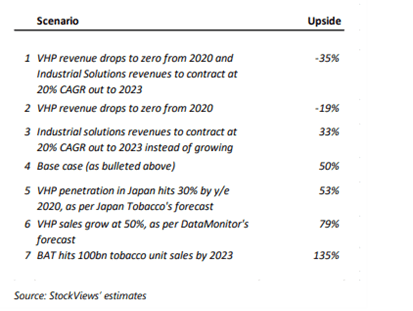
In terms of pricing the market was largely pricing a 4 in 5 chance that this division would be a zero going forwards.  By contrast my detailed modelling, of expansion into new markets and addressable markets in each, forecast a more than doubling of sales in the next three years.

In my base case I saw 50% upside, while also taking the time to model the impact of various potential scenarios:

Why I’m selling out of ATVI

Tuesday 28 March 2023

The risk-reward potential owning Activision Blizzard shares at $85 per share, in anticipation of the closing of the Microsoft acquisition at $95, are no longer compelling.

The EU’s competition authorities and the UK’s Competition and Markets Authority are due to provide their decisions on the merger on the 25th and 26th April, respectively. While in the US, the FTC is scheduled to commence its hearing on 2nd August.

This means that the value for ATVI stock at the end of April will either be $70 (no approval from CMA or EU) or $90 (approval). And at the end of August at $65 or $95.

With the UK’s CMA still investigating the deal with concerns around the implications on the future cloud gaming outstanding (“Previously stated provisional view that deal raises concerns in cloud gaming unaffected” – CMA, 24 March ’23), it’s no sure thing that the UK’s administration will let it pass.

From the current $85 per share price, applying a 50:50 probability to approval by the UK and EU’s competition authorities, we get an expected value of $80 (50% x $70 + 50% x $90) – a negative expected return over the next month.

Post mortem

We invested 10% of our portfolio in ATVI shares at $77 on 31st Jan 2023. Having sold out at $85 on 28th March 2023, we have netted a 10% return in 2 months – equivalent to an 80% annualised rate of return. This is a great result.

But before we start pouring the champagne it’s worth going back to the original thesis, in which I also proposed initiating the trade through a call spread vs. put option structure, paying roughly $1 to initiate. Specifically:

Currently the ATVI June-2023 80-90 Call Spread can be bought while selling ATVI June-2023 65 Puts for around $1…If the merger completes at $95 we make a 10-1 return

Source: My original ATVI buy thesis

This same structure is now trading at around $6 – a 500% return in two months!

In terms of portfolio contribution, supposing the option structure was initiated investing 1% of portfolio capital (as opposed to 10% in shares), this would have yielded a 5% portfolio level return, as opposed to the 1% contribution from the shares we bought (10% portfolio size invested x 10% return).

Suddenly my 10% in 2 months doesn’t sound as good…

Thoughts on Balfour Beatty

Friday 10 Feb 2023

Balfour Beatty (LSE: BBY) has been a zero growth infrastructure builder, financier and maintainer for a decade; with sales more or less flat at £7bn over the period.

What’s more, the business is barely profitable. Operating margins hit a high of 1.5% in FY ’19, albeit up steadily from a low of -5% in FY ’14 (Exhibit 1).

Exhibit 1: BBY has been a low growth, low margin business historically

Source: Company filings

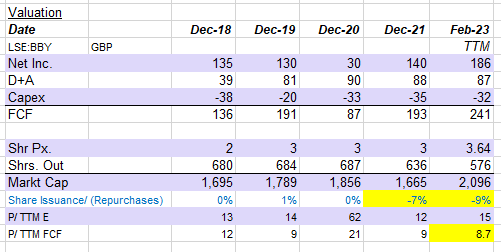
However, with depreciation and amortisation charges exceeding capex, and high single-digit percentage share buy-backs in recent years, the firm has seen FCF per share grow from £0.28 in FY ’19, to £0.42 in the TTM to Jul-22. With shares at £3.64 currently, it trades at an undemanding 8.7x FCF multiple (£3.60/£0.42). (Exhibit 2)

Exhibit 2: Share repurchases and FCF growth have made BBY trade at a cheap multiple

Source: Company filings

Rather than running down cash reserves or employing debt, BBY uses cash from operations to finance the share repurchases. The company operates with £361m in net cash on its balance sheet.

The company is set to buy back up to a further £40m in stock (2% of market cap) by May 2023, and expected to announce further buybacks at its full year results in March, which will further increase FCF per share.

Buybacks of the scale seen in 2022 would drop the firm’s price to FCF per share multiple to 7.8x, well below the medium term average of 12x. A re-rating to past levels would present 50% upside.

The business

Founded in 1909, today’s BBY generates over 80% of its sales from its “Construction Services” segment. In this unit BBY engages in multi-million pound, large scale and complex infrastructure construction mainly in the UK and US. Some examples include:

  1. The £416m project to build seven kilometres of sewage tunnels (Thames Tideway Tunnel “West” section). A key challenge here was removing 800,000 tonnes of clay from a site in central London while minimising the pollution from transportation. They removed the spoil via barges, reducing the lorry-load on London’s roads by 25,000.
  2. The £592m project to build new departure lounges at Heathrow, one of the largest airside projects in Heathrow’s history. The project was completed 5 weeks ahead of schedule and £10m under budget, with the new building 40% more carbon efficient.

In 90% of these projects the customer is a local or national government entity. BBY bids for construction projects and then is responsible for delivering the bridge or tunnel, etc. But this doesn’t leave BBY totally exposed to inflationary pressures. Customers assume liability for the sourcing and supply of building materials, hence bear the cost of price rises on that front.

In addition, to further insulate itself from inflationary pressures, the company uses “buy outs” to pass the cost liability down its supply chain. As of March 2022, 85% of US contacts (50% of group sales) are “bought out” – liability passed to suppliers – within 30 days of getting awarded a contract. But if a subcontractor goes bankrupt, its BBY’s liability to the customer, emphasising the importance of BBY’s knowledge of its suppliers.

The depth and breadth of BBY’s supply chain gives it an advantage in bidding for contracts

Core to BBY’s success is it’s supply chain. The scale of, and expertise within, BBY’s supply chain affects the price they bid for projects and its ability to successfully deliver on time and on budget. In turn, BBY’s ability to win contracts and deliver nourishes its relationships with customers (mostly local and national governments), supporting further wins.

Its supply chain consists of over 10,000 partners, many of which BBY has worked with for over a decade, some of which for over thirty years. Over two-thirds of BBY’s revenue is spent on procuring goods and services from its suppliers.

Some history

In mid-2014, BBY was Britain’s largest construction firm, but was fighting off a takeover bid by rival Carillion.

The firm was bogged down by a large stockpile of low-margin contracts it had accepted following the global financial crisis, and had issued eight profit warnings over the past two years.

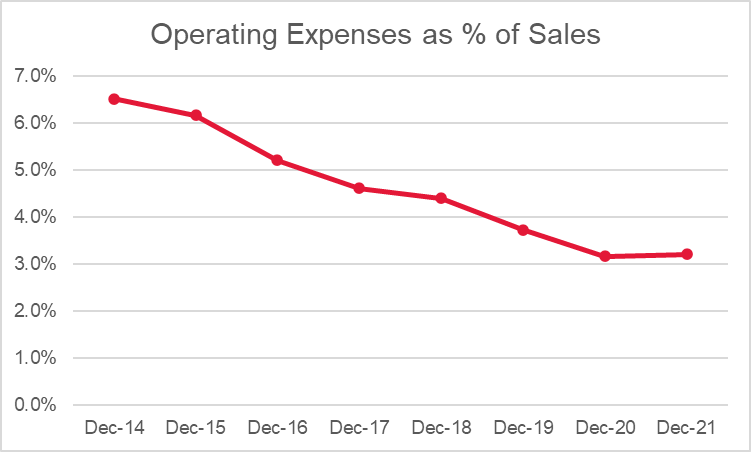
In January 2015, CEO Leo Quinn was appointed who initiated his “Built to Last” programme, one month into his role. Key to this initiative has been streamlining operations, for example selling off assets in the Middle East and stakes in the M25 Connect Plus consortium, re-organising some areas of leadership and greater diligence when acquiring new contracts. This has led to a steady decline in operating expenses over Quinn’s tenure (Exhibit 3)

Exhibit 3: Leo Quinn’s “Built to Last” initiative has halved operating expenses over 7 years

Source: Company filings

Investors appear to be overconfident that inflation will subside and a recession be avoided

Friday 24 February 2023

I believe investors are overconfident in their thinking that inflation is now under control and hence we are likely to see an easing of rates in the next year.  If they turn out to be wrong, we may well see markets reverse the gains they have made by the middle of this year.  The key metric I am currently monitoring to evaluate if investors are wrong is the US Core Inflation, as opposed to US headline inflation.

So let’s dig in.  Let’s start by taking stock of what has happened…

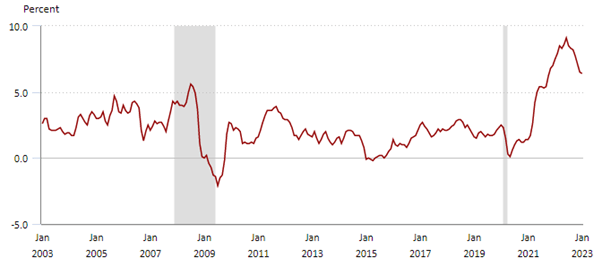
Since October 2022, equity and bond markets have rallied strongly in the belief that inflation is set to subside, believing this in turn will cause central banks to cut interest rates.  The reason they have largely believed this is because between June 2022 and January 2023 US headline CPI, one of the most widely watched inflation measures, has steadily fallen from 9.1% to 6.4% (Exhibit 1)

Exhibit 1: Investor optimism stems from US CPI fall from 9.1% in Jun-22 to 6.4% in Jan-23

Source: https://www.bls.gov/charts/consumer-price-index/consumer-price-index-by-category-line-chart.htm

In the US, the SPX is up about 15% since the lows seen in October 2022, with stocks having an average multiple to earnings of 18x.  To put this multiple into context, this 18x P/E multiple means the market is pricing the earnings of US companies will grow by 10% on average, in 2024.

A similarly optimistic picture can be seen in corporate bonds, where an index of investment grade corporate bond prices is over 9% over the same period.

These imply the strong investor concerns of a recession from just a few months ago, have now been all but forgotten.

On the rates front, looking at bond prices of many OECD countries we can see the market is pricing that central banks around the world will start loosening monetary policy within a year.  And the price of US inflation-linked swaps suggests the US CPI will rise by just 2.9% over the next year.

So combining these data points (the rallying of stock markets, the rise in prices of IG corporate bonds and the pricing of rates cuts) we can see that investors appear to be betting that the cost of goods and labour is set to stabilise.  And with this stabilisation in inflation, the rate cuts that follow will reduce the cost of capital for corporations, boosting corporate earnings and thus help major economies avoid a recession – most importantly, the belief the US will avoid a recession.

There are some important factors to remember when evaluating if the market is currently correct in its pricing.

Historically, the US Fed has a terrible track record at delivering “soft landings” – most rate hike cycles have historically been followed by recessions.  In the past 50 years, there have been 8 tightening cycles and 6 of them were followed by a recession – the exceptions were 1984 and 1995.  What’s concerning, is that both those “soft landings” were preceded by relatively low inflation and accompanied by looser bank-lending standards – the exact opposite conditions to what exist today.

A second datapoint worth weighing is that the most recent rate hike cycle has been the steepest rise in rates seen since the 1980s, and more rate hikes than are currently priced may be required.

The third datapoint, and the most predictive, is the gap between the 10-year and 3-month Treasury yields, which turned negative last October.  This is the ninth time in the past 50 years this spread has turned negative.  All eight of the past instances were followed by a recession.

Based on these factors I currently believe the balance of odds suggests a recession in the US is probable in 2023.

Part of the discrepancy is being caused by where investors are focussed.

While investors are pleased by the decline in headline inflation levels caused by falling energy prices and unplugging of supply chains, central banks are more cautious because of what they see beneath the headline number.  Specifically, they are concerned by the rising level of core inflation, which is being driven higher by prices in services sectors, which are largely a function of labour costs.

With six of the seven G7 countries currently operating with extremely tight jobs market – with levels of unemployment at the lowest level this century – and twice the number of job openings as there are people looking for work, companies are struggling to hire staff.  In many countries including the US, competition for workers continues to create wage growth that is too high to permit inflation of just 2%.  This would imply investors betting on rate cuts by year end are likely to be proved wrong.

The low unemployment levels will likely support wage growth for some time.  If inflation does not fall as investors expect interest rates will stay high or rise further.  Stock markets would face a double whammy, from a higher discount rate, which mechanically reduces asset prices, and an even higher risk of recession.  This would call for a defensively structured portfolio.

What are the key concerns the UK’s CMA is raising about the ATVI-MSFT merger?

Thursday 9 Feb 2023

In a statement released on Wed 8 February, the UK’s Competition and Market’s Authority provisionally concluded that:

Microsoft’s proposed acquisition of Activision could result in higher prices, fewer choices, or less innovation for UK gamers.

UK CMA Provisional Conclusion, 8 Feb 2023

A key concern was that the merger would make MSFT stronger in the growing cloud gaming market, stifling competition and harming UK gamers who could not afford expensive consoles.

The CMA notes that MSFT already accounts for 60-70% of the cloud gaming market, and adding Call of Duty to its offering would give it a quasi monopoly.

Commenting on CMA’s provisional finding, Rima Alaily, Microsoft corporate vice-president and deputy general counsel, said:

“Our commitment to grant long-term 100% equal access to Call of Duty to Sony, Nintendo, Steam and others preserves the deal’s benefits to gamers and developers, and increases competition in the market.”

Rima Alaily, Microsoft corporate vice-president and deputy general counsel

She noted that 75% of respondents to the CMA’s public consultation believe the Microsoft-Activision deal is favourable for competition in UK gaming.

However it is telling that the CMA has now taken a lead in blocking mergers large Tech firms such as Facebook (blocked its acquisition of Giphy) and Microsoft. It has now become one of the most feared trustbusters.

Freed from the EU’s competition policy, the CMA revamped its guidelines in 2020 to give more weight to how post-merger markets might evolve. In Britain and Europe competition cases are pursued in an administrative system, not in a court, as in America. All of which gives the CMA considerable powers.

The CMA’s final report is due for 26th April 2023.