Overview of the key players in the global semiconductor industry

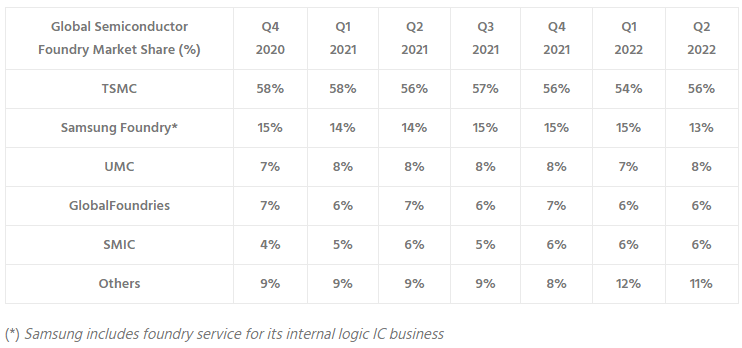
Companies that make chips

Source: Counterpoint research

Nature of business: The more advanced the chips being made the more capital intensive the process. For example, TSMC’s capital expenditure for 2022 will be $36bn, and in December 2022 it announced plans to triple its investment in Arizona from $12b to $40b in the coming years, where it will also bring the more advanced 3nm chips by 2026.

TSMC: More than 90% of the most advanced chips below 10nmn are made by TSMC.

Others: STMicroelectronics supplies chips for automotive and industrial markets that largely use “mature” chip technologies (those with transistors bigger than 10-nanometres)

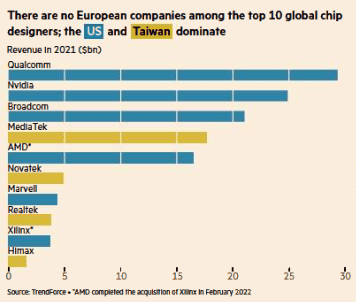
Companies that design chips

Source: FT, “Europe’s bid to compete on chips”, December 14th, 2022

Companies that make the machines needed to make chips

ASML is the only manufacturer of Extreme Ultraviolet (EUV) machines, which are currently used to make 5nm and 7nm chips. The machines are incredibly difficult to replicate; involving 100,000s of components, 10s of billions of dollars of investment and two decades of research. In 2012, Intel, Samsung and TSMC had all invested directly in ASML to make sure it had the funding necessary to build EUV tools their chips would require. Natural light has a wavelength of several hundred nano meters.  So as chips needed to become smaller, smaller wavelengths of light would be required, like EUV light at 12nm.

Tool makers

Applied materials is the world’s largest semiconductor tool-making company.  For example, it makes the machines that apply the thin films of chemicals on top of silicon wafers as they are processed

LAM Research is the world leader in etching circuits into silicon wafers.

KLA has best tools for finding nano-meter-sized errors on wafers and lithography masks.

Carl-Zeiss provides the optical lenses critical for ASML’s EUV machines. They are the only company able to produce these lenses and are 25% owned by ASML.

Software makers to design chips

The software capable of laying out these transistors is provided by 3 American firms:

-Cadence

-Synopsis

-Mentor

–> together have 75% Market share

Why student housing BTLs remain a solid investment

Investment Thesis

Double-digit growth in university students will likely continue to support increased demand for HMOs – homes of multiple occupation- in student cities. This combines with increased costs and regulations for HMO landlords, in addition with local council rules, limiting supply of student homes. Together these are likely to support continued 5%+ growth rates in student rents for the next few years.

In general, with student housing and HMOs typically located outside city centres, benefiting from steady demand from new streams of students each year, the higher yields can make them a good investment even if the overall property market dips.

Growing student numbers increase demand

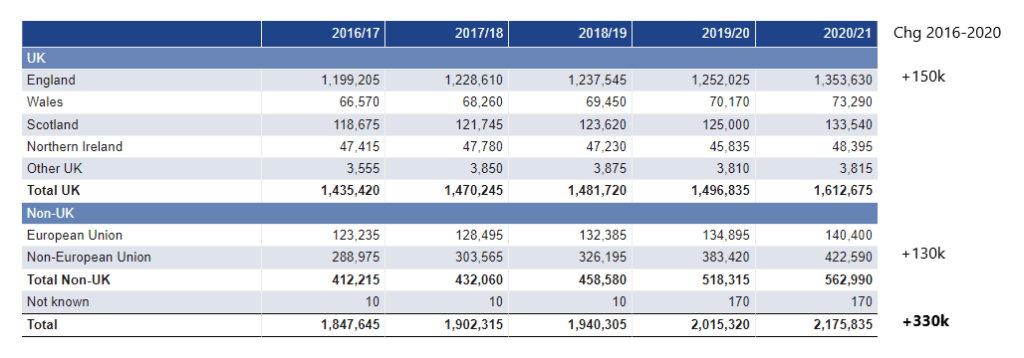
There has been an acceleration in undergraduate intake (Figure 1), this creates resilient demand:


Source: Higher Education Student Statistics: UK, 2020/21

Student intake at English universities has increased every year since 2016. Of the 330k more students in 2020 relative to 2016, more than 80% came from England and Non-EU countries (mainly China, ~30%). This is significant because foreign students have to pay more for their education and therefore would presumably also be able to afford to pay more for their accommodation (Figure 2).

Figure 2: English and Non-EU students drive growth in university numbers

Source: Higher Education Student Statistics 2020/21

Exhibit 1: The percentage of UK 18-21 year olds going to university is increasing

Source: ONS

Exhibit 2: UK population of University age adults is set to increase

Source: ONS

Supply of student accommodation is unlikely to increase dramatically

There is a shortage of student housing in the UK. Currently, the UK has 700,000 rooms in purpose-built student blocks. About 370,000 of these were built by specialist student developers, such as Unite.

According to calculations by Cushman & Wakefield, there are about 2.4 students for every room in purpose-built student accommodation. But houses in multiple-occupation residential properties, preferred by students after their first year, are also under “massive pressure” having been left to pick up the excess demand.

In addition there is also legislation in place in certain councils that limits the number of student homes that can be built. Councils talk of their “responsibility” to ensure student housing does not adversely affect local residents.

The imbalance has led to double-digit annual growth in rental prices in some university towns. Nationally, Cushman estimated student private rents had risen 19.3 per cent, and university rents by 14.5 per cent, since 2016-17.

The worst affected cities include Durham, Manchester, Bristol, Glasgow and York.

This term, first years at the University of the West of England in Bristol were housed in Newport, more than half an hour away by train; those at Manchester Metropolitan University were offered halls in Liverpool, an hour away. Meanwhile, in Glasgow, students were told not to relocate to the city because housing could not be guaranteed.

Source: FT, “University expansion drive collides with UK student housing shortage”, Nov. 8, 2022

Listed provider of student housing, Unite, said they expect sales to grow at 4.5-5% partly as a result of these factors in addition to a reduction in supply from landlords operating HMOs – houses in multiple occupation.

“You then look at the HMO market, so student takes a market that’s got 1 million or so students in it. That market is actually declining as buy-to-let landlords are selling or not renting to students. Therefore, over the course of the next 2 to 3 years, we actually expect a net reduction in the total number of beds available for students to rent at university.”

Richard Smith, Unite Group CEO, Q3 2022 Earnings Call

Landlords operating HMOs have been hit by a confluence of headwinds of late:

  1. Regulations:
    • HMO licenses must be applied for here
    • Landlords must send the council an updated gas safety certificate every year
    • Install and maintain smoke alarms
    • Provide safety certificates for all electrical appliances when requested
    • From 2025, all newly rented properties are likely to require an EPC rating of C or above. While the Bill has not yet been enacted, it states:

(a) all new tenancies must have an energy efficiency performance of at least EPC Band C from 31 December 2025; and

(b) all existing tenancies must be at least EPC Band C from 31 December 20 2028 where practical, cost-effective and affordable as defined under section 1(4).

Source: Minimum Energy Performance of Buildings (No. 2) Bill 

MediaTek: Hurt by US closing Huawei loophole

Source: “Taiwan’s ‘bandit phone king’ hit by US crackdown on Huawei”, FT, 24th August 2020

In May 2020, the US barred chipmakers from selling Huawei any custom-made semiconductors made with US equipment.  For Huawei, this would have made MediaTek’s off-the-shelf smartphone chipsets the obvious choice, a development that would have boosted the Taiwanese chipmaker’s fortunes immensely.  MediaTek’s Dimensity 5G chips are set to be significantly cheaper than Qualcomm’s latest Snapdragon chip, with a long battery life and high energy efficiency.

But the dream was shattered last week when the US Department of Commerce closed the loopholes in its May sanctions by barring the sale of chips made using equipment or US software to Huawei, without a license.  Given the prevalence of US technology in the semiconductor industry, this would include chipsets sold by MediaTek.

Even if Huawei is pushed out of the smartphone market, and the market share vacuum taken up by Chinese rivals such as Oppo, Vivo or Xiaomi, it could still be a problem for MediaTek.  These competitors are likely to take up MediaTek’s cheaper offering, the Dimensity 700 chips, rather than the more expensive variety of 5G chipsets Huawei was expected to use.

According to analysts, the US government could still issue licenses for certain suppliers if vital US interests were at stake.

History

MediaTek spun off from United Microchip Corporation, the Taiwanese chipmaker, in 1997.  It built its business designing chips for CD drives and later DVD drives, before moving into chips for TV sets and finally mobile devices.  It has grown to become Taiwan’s largest and the world’s fourth-largest chip design company.  Its biggest break came after it started offering a turnkey solution for mobile phones in 2004 that enabled scored of no-name workshops manufacturing knock-off handsets – “bandit phones” – in the southern city of Shenzhen to produce more sophisticated products.  For small factories, the platform included a chipset and reference designs for phone features that they would not have been able to develop themselves.

How Ratuken’s OpenRAN solution sidesteps software traditionally provided by Huawei, Ericsson and Nokia

Source: FT, Jul-2020, “Telecoms networks look to fix Huawei problem with open source software”

The nascent “OpenRAN” movement is now on the verge of launching a national 5G network without the help of Huawei or its main European competitors Ericsson and Nokia.  The competing technology is provided by ecommerce group Ratuken, which has been working on Japan’s first new mobile radio access network (“RAN”) in a decade.  Ratuken’s launch is a key moment in proving whether open sourced-based network technology can work at scale and comes against a backdrop of global pressure to foster alternatives to Huawei’s telecoms technology.

Traditional mobile networks rely on equipment that tightly bundles together proprietary hardware, such as antennas and cabinets, with software provided by the three large vendors.  Ratuken is trying to unbundle this arrangement, using open-source software to operate Ratuken’s new network, which is the first full OpenRAN system in the world.

With this system Ratuken representative Tareq Amin states that he could bring a new radio mast online in just over eight minutes, compared with between five to ten days for a traditional outfit.  The cost of launching a 5G network, he said, was 45% lower than using traditional equipment.

Ratuken is not alone in pushing for a shake-up of the market.  In 2018, NTT, Orange, China Mobile and AT&T formed the OpenRAN alliance to explore the idea, while Facebook is also looking into the technology via the Telecom Infra Project.

If OpenRAN becomes popular, mobile networks could pick and choose software and hardware from a range of vendors rather than being locked in to proprietary technology for years.

Open systems would allow smaller software players including Mavenir, Parallel Wireless and Altiostar – in which Ratuken has invested – to compete.  Meanwhile, suppliers such as NEC, Fujitsu and Samsung could regain a foothold in the global telecoms hardware market.  In response, struggling Nokia has now embraced open-source software. Radio access equipment represents as much as 70% of an operators capital expenditure, so Ratuken’s initial success, with 1m customers signing up so far, has encouraged other new entrants, such as Dish in the US and 1&1 Drillisch in Germany.

Common stocks and Uncommon Profits, Philip A. Fisher

Buy the book on Amazon

Filtering companies

The ratio of “companies looked at” to “companies visited” was probably one in every forty or fifty.  Its worth mentioning I believe it so impossible to get much benefit from a plant visit until a great deal of pertinent “scuttlebutt” work (primary research) has been done first.

What to buy

Consider that all senior convertible issues have been converted and all warrants/options been exercised when calculating the real number of shares outstanding.

When to sell

If I have a deep conviction about a stock that has not performed by the end of three years, I will sell it. (p245)

Sell a stock if it can no longer grow faster than the economy as a whole or management has failed to grow as companies have grown (p276).

When to hold

After a sharp advance, a stock nearly always looks too high to the financially untrained.  It is a mistake to sell a company with unusual growth prospects to realize a good gain when the shares look temporarily overpriced.  These investors seldom buy back at higher prices when they are wrong, and lose further gains of dramatic proportions. (p263)

Do not disturb a position that is going to be worth a great deal more later.  If the growth rate is so good that in another ten years it’s (free cash flows) may have quadrupled, it shouldn’t be of great concern that its 35% overpriced now. (p111).

There are times when a stock is worthy of retention by conservative investors who own it, but not for fresh purchase with new funds.  The great qualities of these companies have become almost legendary in the financial community and thus have been awarded price-to-earnings ratios higher than is warranted by even the strong fundamentals.

The reason to continue holding on to these overpriced companies is because if the fundamentals are genuinely strong, these companies will in time increase earnings not only enough to justify present prices but to justify considerably higher prices.

Secondly, there is always the risk of switching to from this high quality business to one that looks like quality but actually isn’t.  It’s actually safer to hold on to the great business which might be temporarily overpriced.

Those that choose to sell seldom get the opportunity to buy back at the lower price they were hoping for.  They also wait for a decline to be bigger than it actually turns out to be. (p211)

Conducting primary research

Reading the printed financial records about a company is never enough to justify an investment (p233).  One of the major steps in prudent investment must be to find out about a company’s affairs from those who have some direct familiarity with them.  It is also necessary to learn as much as possible about the people who are running the company.

I will try to see (or reach on the telephone) every key customer, supplier, competitor, ex-employee, or scientist in a related field.  Frankly, if I’m not even close to getting much of the information I need, I will give up the investigation and go on to something else.

Ask to be introduced to the people you need to speak to; be frank about who you want to meet and why.  Be clear the information you are seeking is solely for background purposes in determining whether to make an investment. (p167).

Never visit the management of any company he is considering for an investment until he has first gathered at least 50% of the knowledge he would need to make an investment.

Qn: “What is the most important long range problem facing your company?”

When to discard an idea

  1. Evidence piles up that the company is just run of the mill
  2. You are unable to gather enough evidence

Why poorer businesses can outperform in a boom period

Take two companies LeanMachine and HighCosts, each selling machines for $10 each.  LeanMachine has profits of $4 per machine while HighCosts only has profits of $1 per machine.  Suppose now in the boom period the demand for machines goes up and the sales price rises to $12 per machine.  LeanMachine will see its profit per machine rise to $6 (a 50% increase), but HighCosts will see its profit per machine rise to $3 per machine (a 300% rise). (p181)

Importance of marketing

In the competitive world of commerce it is vital to make the potential customer aware of the advantages of a product or service.

Management

Of one thing the investor can be certain: A large company’s need to bring in a new CEO from the outside is a damning sign of something basically wrong with the existing management (p189).

How well-managed companies maintain above-average profit margins

Economies of scale.  Quite often as companies get larger it becomes harder to run efficiently with too many layers of bureaucracy.  On the other hand, when a company becomes the leader in its field, not just in dollar volume but in profitability, it seldom gets displaced from this position as long as its management remains highly competent.  The scale enables the cost of operating its fixed assets to be spread over a higher volume of sales, thus reducing production costs per unit.  The scale also makes it easier to attract customers because of a well-recognized trade name.  But importantly there may also be structural advantages.  Campbell Soup, for example, has built up a network of canning sites across the US which reduce the haulage costs from the growers to the canning site and from the canning site to the supermarket.

Switching costs.  An example might come in the form of a company that has created in its customers the habit of almost automatically specifying its products for reorder in a way that makes it rather uneconomical for a competitor to attempt to displace them.  This can happen when a company has built up a reputation for quality and reliability in a product that:

  • The customer recognizes is very important for the proper conduct of his activities
  • Where an inferior or malfunctioning product would cause serious problems
  • Where the company is synonymous in the public mind with the source of supply
  • Where the cost of the product is quite small relative to the cost of operations.  Hence moderate price reductions only yield very small savings for the customer.

        Second, the company must have a product sold to many small customers rather than a few large ones.  These customers must be sufficiently specialized in their nature that it would be unlikely for a potential competitor to feel they could be reached through advertising media such as magazines or television.  They constitute a market in which, as long as the dominant company maintains the quality of its product and the adequacy of its service, it can be displaced only by an informed salesperson making individual calls.  Yet the size of each customer’s orders make such a selling effort totally uneconomical. (p205)

Evaluating a price move

-Have the fundamentals changed or is it the appraisal of the fundamentals that has changed?

-The conservative investor must be aware of the nature of the financial-community’s appraisal of a stock or industry and whether is it more or less favourable than the fundamentals warrant. (p217)

Valuation

The further into the future profits will grow the higher the price-to-earnings multiple ratio an investor can afford to pay. (p219)
How private equity firm Silver Lake used (needed) financial engineering, tough negotiating and luck to make a profit investing in a terrible business

Source: FT, Friday 5th Feb 2021

Having taken on $500m in senior debt during the pandemic from investors including Apollo Global, AMC Entertainment, the cinema operator, quickly found itself burning through $100m in cash per month with no-one going to movie theatres.

In order to buy itself time, AMC embarked on a complex refinancing program, pitting existing lenders including Apollo against firms wishing to participate in the rescue package, which included Silver Lake Partners.  Lucky for Silver Lake, it was their proposal that prevailed in the AMC boardroom.

Lucky, because Silver Lake was already in a tough spot; in 2018, they had bought a $600m convertible bond from AMC.  They believed the firm could prevail despite the headwinds from streaming providers and thought the 3% coupon on the debt-component would provide a floor.

The convertible however had one unattractive feature; it was unsecured.  This put it behind any senior debt in the case of bankruptcy.  And by June 2020, the company was in fact on the verge of bankruptcy – junk debt was trading at 30c on the dollar and the even the senior debt was trading in the 60s.

Silver Lake’s proposal entailed them putting in $100m at the senior level and the junior bondholders would swap $2bn of debt for $1.5bn at a higher interest rate and for a longer maturity.  Most controversially, Silver Lake would have their $600m convertible bond leapfrog to the most senior creditor level.  This meant they would now share in any cash that might be recovered should AMC’s assets have to be sold off in a bankruptcy scenario.

By November 2020, with the prospect of BioNTech/Pfizer’s COVID vaccine looming, prospects of an economic recovery started to rise.  AMC shares shot up as they announced plans to sell shares to the public through a so-called “at-the-market” programme where it could simply place shares opportunistically during trading hours. To add to this, in late January 2021, shares in AMC surged as Reddit readers and day traders piled into the stock rising to close to $20 per share at one point.  Silver Lake converted their bonds into equity at $13.51 and sold the 44m shares at a price of $16.05, netting the private equity firm a $113m profit.

Chinese battery makers set to take the lead in Europe

Source: FT, Wednesday 7th December 2022

Key insights:

  1. “According to Benchmark Minerals, China will have 322 gigawatt hours of production capacity in Europe by 2031, with South Korea the second largest operator in the region at 192GWh, followed by France and Sweden. The US is fifth, thanks to Tesla’s plant in Berlin, followed by Germany and Norway. The UK is eighth with 20GWh.”
  2. “VW is foremost among European manufacturers trying to expand battery capacity and reduce reliance on external suppliers. It wants to build five factories in Europe, as well as one in North America. But in the meantime it has a supply deal with China’s CATL, the largest battery maker.”
  3. “CATL is a supplier to VW and Mercedes-Benz, while BYD — which also makes its own batteries — has a deal with Stellantis. Envision AESC, a battery group backed by China’s Envision, supplies Nissan in the UK and may build more plants in France and Spain.”

What are the US housing trends we are seeing in DFH markets?

Thursday 10th November, 2022

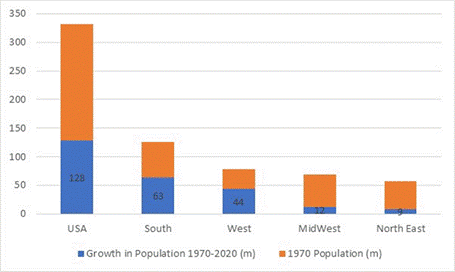
Dream Finders Homes is predominantly operating in Southern US states, which are benefiting from long-term positive migration trends. (Exhibit 1)

Exhibit 1: Almost half of US population growth since the 1970s has been in the South

Source: US Census Bureau

Key drivers being warmer weather and lower state taxes (State income taxes in TX and FL are 0%), with the option to move partly facilitated by hybrid/ remote working.

For the 9 markets DFH operates in, prices are strongly up so far this year. (Exhibit 2)

Exhibit 2: Median house prices in DFH markets have continued to rise in 2022 (% Chg)

Source: Zillow

However in five of the states: Denver, Washington D.C., Raleigh, Austin and Dallas prices are off between 1-5% from their May-July highs. (Exhibit 3)

Exhibit 3: House prices have started to decline in five of DFH’s nine markets

Source: Zillow

Given the spike in US home prices, do you think its fair to assume home prices will rise at 5.5% CAGR going forwards?

Thursday 10th November, 2022

Yes it’s a good spot. Median house prices in the US rose 18% in 2021, following +5% and -2% price changes in 2020 and 2019, respectively.  This 18% rise also looks high relative to the median household income line of best fit. (Exhibit 1)

Exhibit 1: The sales prices of new homes in the US shot up 18% in 2021

Source: US Census Bureau

In the short term (in 2023) I would agree it is fair to expect some mean-reversion, which would cause house prices to fall.

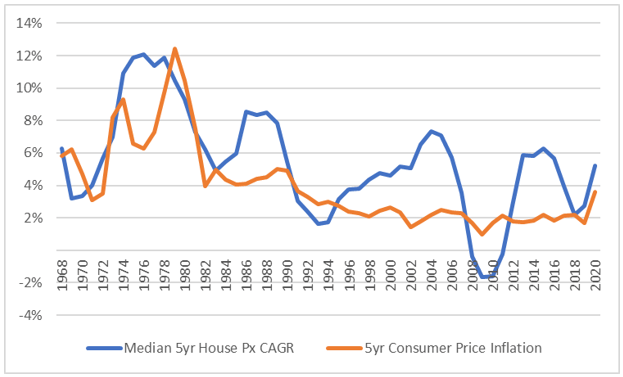
However, when forecasting over a 3-5 year window, it is necessary to also incorporate inflation rates into an assessment of future house prices.  So far this year, median US house prices are *up* ~9% (the exact change varies based on the data source: US Census Bureau +7.4%, Zillow +10.4%.)

It can be seen in Exhibit 2 below that the CAGR at which house prices have grown have almost always exceeded inflation.  With the June 2022 CPI print at 9.1%[1], I think 5.5% CAGR in average new home sales prices over the next 5 years remains fair.

Exhibit 2: The rate of house price growth is almost always above inflation

Source: US Census Bureau


[1] https://www.bls.gov/charts/consumer-price-index/consumer-price-index-by-category-line-chart.htm